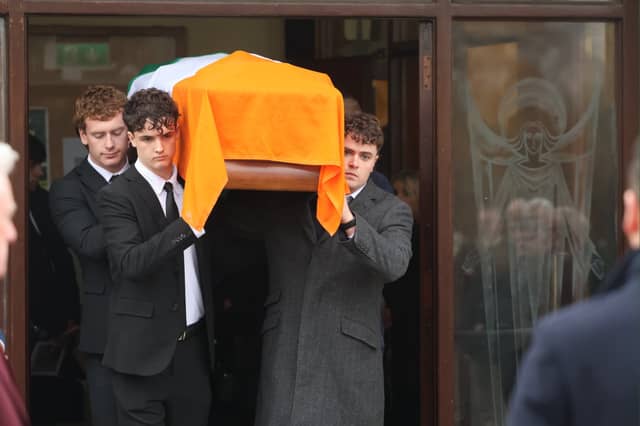
Former minister Gerry Collins’ coffin, draped in the Irish Tricolour, being shouldered out of Abbeyfeale Church | PICTURE: BRENDAN GLEESON
THEN MINISTER for Foreign Affairs Gerry Collins travelling from Damascus – after helping to free hostage Brian Keenan in 1990 – to Tournafulla for the funeral Mass of a parish priest encapsulated the international statesman who never lost the local touch, his funeral Mass heard this Thursday.
Taoiseach Micheál Martin, President Catherine Connolly’s Aide-de-Camp, former Taoiseach Bertie Ahern and Fianna Fail ministers and councillors were among the mourners in The Church of The Assumption in Mr Collins’ native Abbeyfeale. The 88-year-old passed away on Sunday after an illness bravely borne.
The Mass was delayed due to the number of mourners queuing in the aisle to offer their condolences to Mr Collins’ wife Hilary and family members. A long line commenced again to pay their respects after the Mass was over.
Mr Collins long political career began when he was first elected to Dáil Eireann in 1967, winning a seat in the Limerick West by-election following the death of his father, James Collins. Mr Collins was re-elected at every subsequent general election, until his retirement from Dáil Eireann in 1997. He also served as a Member of the European Parliament for Munster between 1994 and 2004.
Chief celebrant Monsignor Tony Mullins said the presence of so many was a wonderful reflection of the affection and the respect in which Mr Collins was held.
“He was a charismatic man who had a wonderful natural ability to connect with people. He had an easy charm about him that was both disarming and endearing. He treated everyone, regardless of their political persuasion or point of view, with genuine respect and courtesy.
“There’s no doubt Gerry loved his work as a politician, and his interest in public life and in the affairs of our country never diminished. Indeed, he remained deeply interested and engaged right up to the very end of his life. And that in itself says a great deal about the depth of commitment and the passion that he had for the work to which he had devoted all of his life.”
Taoiseach Micheál Martin was one of the mourners
Monsignor Mullins said Mr Collins was at ease in the company of all.
“He made time for everyone, and importantly, he knew how to listen. He was gracious and kind in his dealings with people. And if there was something he could do to help, he would do it. Those who came to him for advice or help found in him not only a willingness to help, but also a reassuring presence.
“He had a way of putting people at ease, of making them feel that their concerns mattered and that they were not alone in their struggle. I have no doubt but that what underpinned Gerry’s deep sense of public service and public duty was his firm belief that anything he could do as a public representative to improve the lives of his fellow citizens was worth giving his time, his energy, and his commitment to. He saw this not simply as a responsibility, but as a kind of mission.”
Symbols of Mr Collins’s life included Bunreacht na hÉireann (Constitution of Ireland), which reflected his commitment to his country, to democracy, and to the people of Ireland. A European Merit Medal which was presented to Mr Collins by the EU in 1992 in recognition of his dedicated service to Ireland and his commitment to international cooperation and a united Europe.
A silver lobster from Kells Bay was brought to the altar to demonstrate his love of times holidaying and fishing in County Kerry. Lastly, a jar of mustard to symbolise the many happy memories of sitting around the dinner table, enjoying dinners, and very lively conversation with friends.
Former Taoiseach Bertie Ahern travelled to Abbeyfeale for the funeral
Monsignor Mullins said despite all his trips abroad Mr Collins had to return to West Limerick nearly every weekend. One story sums that love of home perfectly.
“This was where he was from. This is where he was truly connected. This was his place. I think those of us who followed Gerard’s career will always remember the high points of his ministry and his public life. But one that I was reminded of myself when I was reflecting on his life in recent days was when he put so much work into securing the release of Brian Keenan, who was held hostage in Beirut for four-and-a-half years in the late 1980s.
“I can recall watching Sky News, which was new at the time, late into the night, as Gerard, in his role as foreign minister, traveled to Damascus on the government jet to bring Brian Keenan back to Ireland. It was an extraordinary moment, attracting wall-to-wall media attention and coverage right across the world.”
The following day here in West Limerick, in the parish of Tourinafulla, the dioceses and the local community were gathering around midday to celebrate the funeral Mass of its parish priest, another Abbeyfeale man, the late Fr Dan Murphy.
“Needless to say, all the talk in the sacristy among the priests before Mass was about the release of Brian Keenan and the role Gerard played in it. There was pride in the fact that it was, it was one of our own who was on the world stage, and even the Fine Gael clergy were in agreement. At midday, we began the funeral Mass for Fr Murphy, and at one stage during the Mass, there was a bit of activity and noise around the main door of the church.
“And when the door opened, in walked Gerard. Twelve hours earlier, he was in Damascus with world media attention on him. A few hours later, he was in Tournafulla at the funeral of the local parish priest. That was Gerard. His own community was always a priority for him, standing in solidarity with the parishioners of Tournafulla on the death of Fr Dan Murphy.”
Monsignor Mullins recalled that in the sacristy afterwards, one of his colleagues, said, “Dan Murphy must have done a Monsignor Horan on it and built a runaway in Tour’ so that the government jet could land on it!”
“But that was Gerry. He was always rooted at home. He never lost that connection. And in recent years, as Gerard’s health declined, he faced the many challenges that his advancing years brought with great dignity, with great determination, never seeking limelight or help.
He carried it all silently. He faced his ill health with a strength and a spirit, I suppose that was characteristic of him persevering to the very end. The words of the second reading from St. Paul today, ‘I have fought the good fight, I have finished the race, I have kept the faith’.
“Gerard has certainly run his race. He has remained faithful to the values and the convictions that shaped his life, values that were rooted in his Christian faith, and he leaves behind a legacy of service, commitment, and faithfulness that will continue to inspire us.”
Nephew Michael Collins gave a beautiful eulogy which touched on everything from the very difficult days of the Troubles to meetings with Nelson Mandela and Margaret Thatcher.
“On behalf of Gerard’s wife, Hilary, his sister, Mary, the Collins family, and all of us who loved him, thank you for being here today to celebrate and remember Gerard. To the wider world, Gerry Collins was a giant of Irish politics. A long-serving TD for West Limerick, a cabinet minister in many of the highest offices of state, and a vice president of the European Parliament.
“But to those who knew him best, he was simply Gerard, a devoted husband, a faithful friend, proud Abbeyfeale man, and a person whose warmth, wit, and deep humanity touched everyone who crossed his path”.
For 30 years, election after election, West Limerick returned Mr Collins at the top of the poll.
“But no matter what duties he had in Dublin or beyond, Gerard was firmly connected to his roots. His commitment to West Limerick was absolute, and he was always available to the people of Abbeyfeale and all across the county.
“At home, the phone rang continuously day, night, and weekends. As Minister for Justice in the late 1970s during the very difficult days of the Troubles, Gerard was at the centre of some of the most challenging security crises in modern Irish history. Even though I was just a young lad back then, I can vividly remember the intense and relentless pressure and the constant threat to his personal safety, and I know that it required immense physical stamina and mental strength from both Gerard and Hilary at the time.”
Michael Collins said his uncle relished his time as Minister for Foreign Affairs.
“He loved diplomacy because at its core, diplomacy is about human beings. Whether in a local debate, sitting in the Dáil, or negotiating at an international summit, Gerard understood one fundamental truth. Behind every ideology and every negotiating table, there is a person with cares, feelings, and emotions.
“He had an innate ability to make genuine, warm, personal connections with anyone he met, regardless of their rank or their background, and those connections often blossomed into friendships that lasted long after the official duties had ended. Crucially, making those human connections never meant compromising his principles.”
He said Mr Collins had a powerful moral compass, a deep-seated belief in right and wrong, and an absolute intolerance for injustice.
“These are the strong principles that always made me most proud of uncle Gerard, and that I have always tried to learn from and live by. We saw his moral compass in action on the world stage in February 1990.
“As Ireland’s Minister for Foreign Affairs and President of the EU Council of Ministers, Gerard took a principled, resolute stand on South Africa. When others were pushing to ease sanctions on the apartheid regime, Gerard held the line, insisting that European pressure must remain until genuine, lasting change occurred because the South African people deserved better.”
Just 16 months later, in June 1991, apartheid legislation was formally repealed.
“Gerard told a lovely story about meeting Nelson Mandela in Zambia in 1990, shortly after Mandela’s release from prison, and presenting him with a copy of The Book of Kells. Mandela didn’t have his glasses with him, so he borrowed Gerard’s glasses to view the book, and apparently Mandela was very knowledgeable about The Book of Kells.
“There’s a great photo up in Gerard’s office of Mandela wearing Gerard’s glasses. But when he was finished, Mandela put the glasses into his top pocket, and he insisted they were his own. And Gerard didn’t have a second pair with him, so he said it took all his charm and diplomatic skills to get his glasses back from Nelson Mandela.”
Mr Collins also had a sharp wit that no diplomatic protocol could suppress, even with the Iron Lady.
“In 1990, after a meeting of EU heads of state in Dublin Castle, Gerard was accompanying British Prime Minister Margaret Thatcher out of the meeting and down the steps to her waiting motorcade. Mrs Thatcher turned to Gerard and said, ‘Collins, we left you some very nice buildings, didn’t we?’ Gerard smiled his trademark smile and replied, “That’s only because you couldn’t take them with you.”
Through every step of Mr Collins’ journey, every election, every storm, every late night phone call, he had his anchor, his wife, Hilary, said Michael Collins.
“Gerard and Hilary met at an Abbeyfield Badminton Club dance in Killarney in 1965, and for over 60 years, Gerard was blessed to have Hilary as his partner, his confidant, and his strongest supporter. Whatever political storm was blowing outside, home with Hilary was where Gerard drew his strength.”
Michael Collins said his uncle was immensely proud that his nephew, Niall, had so strongly continued the Collins family political tradition.
“Whether Gerard was steering a boat off the Kerry coast or navigating complex international negotiations, he stayed steady at the helm, he kept his eyes on the horizon, he looked after his crew, and he made his way home to Hilary at the end of the day.
“When Gerard was asked to explain what motivated him through all the decades of relentless work and high pressure, he didn’t offer a complicated political philosophy. He would often answer with a simple phrase that I heard him say many times over the years, ‘Because the people deserve better’. It wasn’t a slogan.
“It was the moral anchor of everything he did. Whether it was his family, his neighbors in Abbeyfeale, the people of West Limerick, of Ireland, or of Europe, Gerard truly believed that the people deserved the very best, and every day of his life, he gave us exactly that. Gerard, thank you for your service, your courage, your humor, and your love. May your gentle soul rest in peace,” concluded Michael Collins.
At the end of the funeral Mass, Taoiseach Micheál Martin and Minister of State Niall Collins unfurled the Irish Tricolour and placed it on Mr Collins’ coffin. Niall Collins gently placed his hand on the coffin as a final farewell.
The coffin was shouldered down the aisle and onwards to Mr Collins’ final resting place in Reilig Íde Naofa, Abbeyfeale.
