Irish 35C heatwave school closures update as 139-year Met Eireann record at risk before ‘explosive’ tornado & storm turn
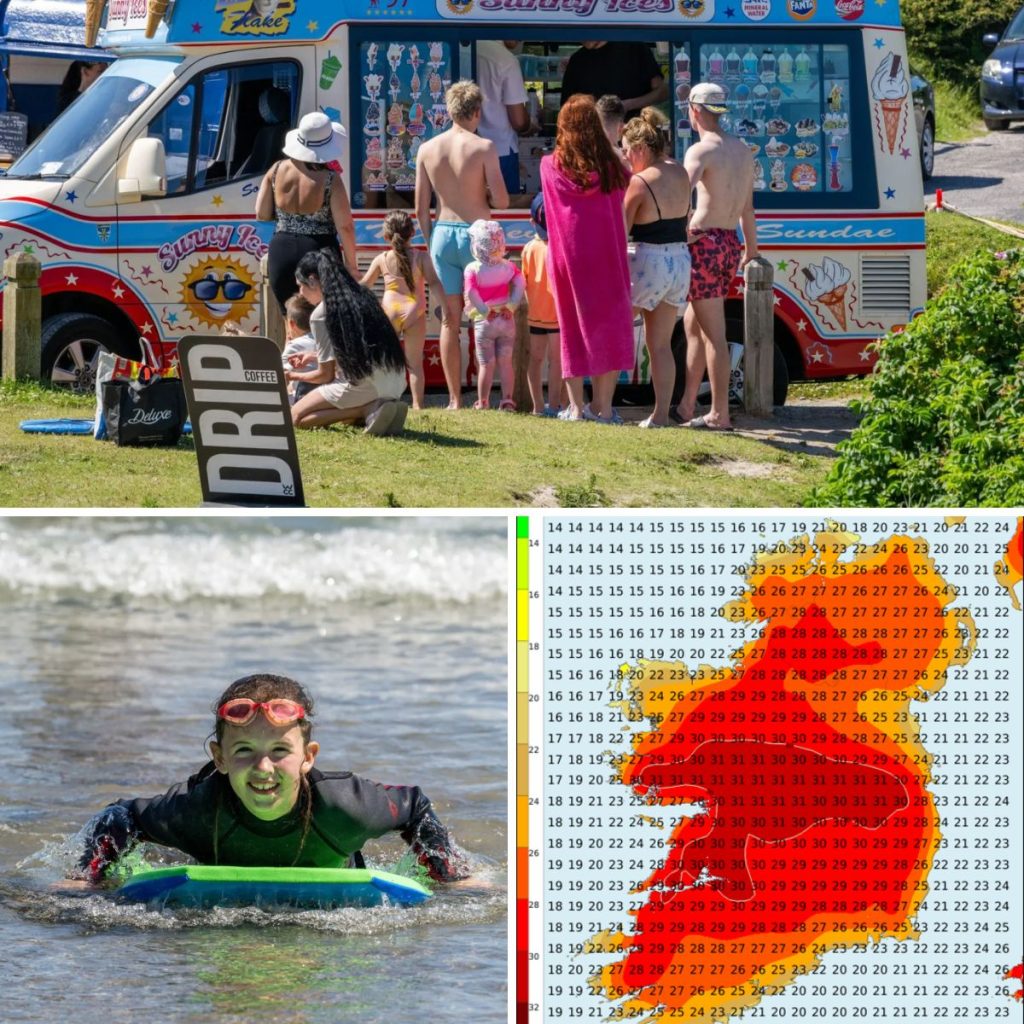
MET Eireann has warned Ireland’s all-time high temperature record from 1887 could be broken tomorrow as the mercury soars to a blistering 35C.
And the “exceptional” heat, combined with high humidity and tropical nights that offer no temperature relief, has sparked fears there will be “potentially serious health consequences” for those who can’t keep cool.

However, the Department of Education said it is not anticipated that it will be necessary for schools to close this week due to the hot weather.
A spokesperson added: “The department will monitor the situation as it progresses and will follow any advice from the National Emergency Coordination Group.
“Schools are expected to follow the usual guidance for such events, including scheduling learning to avoid excessive time in the sun and encouraging the use of sunscreen and hydration.”
The highest temperature recorded in Ireland was 33.3C in June 1887 at Kilkenny Castle – with the record coming close to being broken in 2022 after temperatures hit 33C in Dublin’s Phoenix Park.


Met Eireann Meteorologist Matthew Martin said: “We certainly do have potential to go close to that record tomorrow.
“It all really depends on if we see some cloud building up during the day, and that could put a cap on the peak of those temperatures.”
Speaking on RTE’s Today with David McCullagh, Martin said temperatures will be in the high 20s, but could rocket to 32C in parts of the west.
And he warned that the muggy and hot conditions today and tomorrow will make for two uncomfortable nights.
He said: “Parts of the midlands and south may experience a tropical night tonight and then more widely tomorrow night across parts of the east and south, so some very uncomfortable sleeping conditions likely.”
But McCullagh said we will return to “more typical Irish summer weather” over the weekend and next week – after the hot spells break down and thunderstorms hit Ireland tomorrow and on Friday.
Cathal Nolan from Ireland’s Weather Channel said tomorrow’s weather will be “truly exceptional” for a number of reasons – explaining that some parts of Dublin City and Connacht could hit 34C and 35C.
He said areas around Phoenix Park could break the high temperature record as air warms while it pushes over the Wicklow and Dublin mountains, which can lead to temperature spikes.


Nolan said this, combined with the urban heat effect as air passes over the city, looks likely to leave the area west of Dublin City baking.
And he warned that areas of Galway, Mayo, Roscommon and Sligo are also in the running to break the record, with models showing temperatures reaching a “phenomenal” 35C.
The weatherman said dew point temperatures of up to 23C are a point of worry for forecasters – as this makes it more difficult to cool down and could lead to a number of people suffering from heat stress.
He said: “You may think we’re over-exaggerating this when we say it, but you will really notice the difference tomorrow in terms of that dew point temperature combined with that plume of very hot air, leading to very uncomfortable conditions and a tropical night to come both tonight in many parts and especially so tomorrow night.”
Another area of “concern” is the risk of “really intense and severe” thunderstorms due to hit parts of the northwest.
Nolan said: “The intense heat and phenomenal dew point temperatures will serve as the fuel required to release some explosive thunderstorms tomorrow evening and overnight into Friday across the northwest.
“All necessary parameters indicate the development of intense, long lasting thunderstorms in the northwest.”
Nolan warned Convective Available Potential Energy (CAPE) levels, which measure the atmospheric instability, are “off the charts in terms of intensity.”
And this brings the “very real risk” of intense lightning strikes, very large hail, damaging winds, “tremendous amounts” of rain localised flooding and “even an outside chance of tornado activity.”
Nolan said parts of Donegal, Derry, Tyrone, Fermanagh, Leitrim, Sligo and Mayo are forecast to be hit by the storms, adding: “They’re storms more so that we would see replicated across continental Europe or indeed into parts of America.
“It’s a very unusual situation. I’ve never seen the atmospheric conditions come together in this manner in the context of Ireland over the course of my 33 years of observing weather.
“So it is a very interesting but concerning forecast indeed.
“You may even hear mentioned the possibility of very slight risk of tornado activity into parts of the northwest tomorrow. I can literally see the eye rolls as I say that.
“There is a small risk of tornado activity given the conditions that we have in place tomorrow. So while it is a risk, it’s a very small risk, it’s not something to become overly alarmed or concerned about.”
The National Directorate for Fire and Emergency Management (NDFEM) confirmed it is coordinating with key stakeholders to prepare for the high temperatures.
Director Keith Leonard emphasised: “While the warm weather will be welcomed by many, it also brings risks that may not always be obvious or anticipated.
“The public should plan ahead, keep up to date with Met Eireann forecasts and warnings, and take appropriate precautions in relation to heat, water safety, thunderstorms and the possibility of localised flooding.”
The NDFEM is urging the public to be mindful of wildfires and not to swim in places that don’t have a lifeguard.
Kieran O’Donnell, Minister for Older People, has advised older people to avoid direct sunlight and to keep hydrated to help remain safe during the hot spell.
He said: “Heat stress, heat exhaustion and heatstroke can have potentially serious health consequences for people during a heatwave.
“I would urge older people, and those caring for someone, to take precautions to protect themselves such as staying cool and hydrated, and to be on alert for signs of heat exhaustion and dehydration.
“It is important to remember that your GP or pharmacist will be able to advise you if any of your medicines might make you more likely to become ill from the heat.”